
End of the Road in Southwest Alaska


I’ve written on this before, but I seem to be attracted to roads with no return, no way back but to retrace my steps… paths and highways with nothing beyond… the end of the road…. that absolute final terminus.
Washington’s Route 542 to Heather Meadows on the flank of Mt. Baker; Sagres, Portugal, the southwestern most tip of Europe (before the Age of Discovery, the edge of the known world); British Columbia’s Chilcotin Highway to Bella Coola; and Lund at the northern point of the Sunshine Coast; Maui’s Road to Hana; and one unpaved coastal road in Iceland’s West Fjords (Route 643) that ends on a beautiful, solitary, black sand beach, the home of Atlantic puffins and arctic fox. These are some of my favorite drives (I recommend them all!), and each lead to some place magical, less trodden, a place where I can gaze into the distance and envision other lands and cultures far away across the mountains or seas.

Alaska, our 49th State, has its share of end of road adventures. The Dalton Highway starts north of Fairbanks and is over four hundred miles of gravel that crosses the arctic circle and ends in Prudhoe Bay (the longest dead-end drive in the U.S.). The Alaska-Canadian Highway (ALCAN) officially ends its nearly 1,400-mile journey in Delta Junction. And the McCarthy Road, winding sixty miles through Wrangell-St. Elias National Park and Preserve until it ends at the hiking-only Kennicott River Bridge. The Dalton and McCarthy are end-of-the-road routes that I have not yet traveled, and I can’t wait to fill in those missing adventures on my photography travels in the near future.

On my most recent trip, I found myself heading south in Alaska from Anchorage on the Seward Highway, which ends at Resurrection Bay and is the gateway to Kenai Fjords National Park. Not surprising, it took me a long time to get there! I was driving with my wife and family members Chris and Jeff, and it was their very first time in Alaska. So we stopped to look for moose in nearby wetlands, bald eagles in Potter Marsh, Dall sheep (tiny white specks far above us), and beluga whales (none on this trip) on our drive down along Turnagain Arm.

We spent a few days in the Seward area hiking to Exit Glacier and watching salmon spawn in local creeks and streams. We then backtracked a few miles and headed west on Alaska’s Sterling Highway, across the Kenai Peninsula (“Kahtnuht’ana” the native Dena’ina name for the Peninsula) on our way back to Homer Alaska. We drove along the Kenai and Russian Rivers, watching coastal brown bears and anglers fishing along quietly flowing aqua-blue waters.

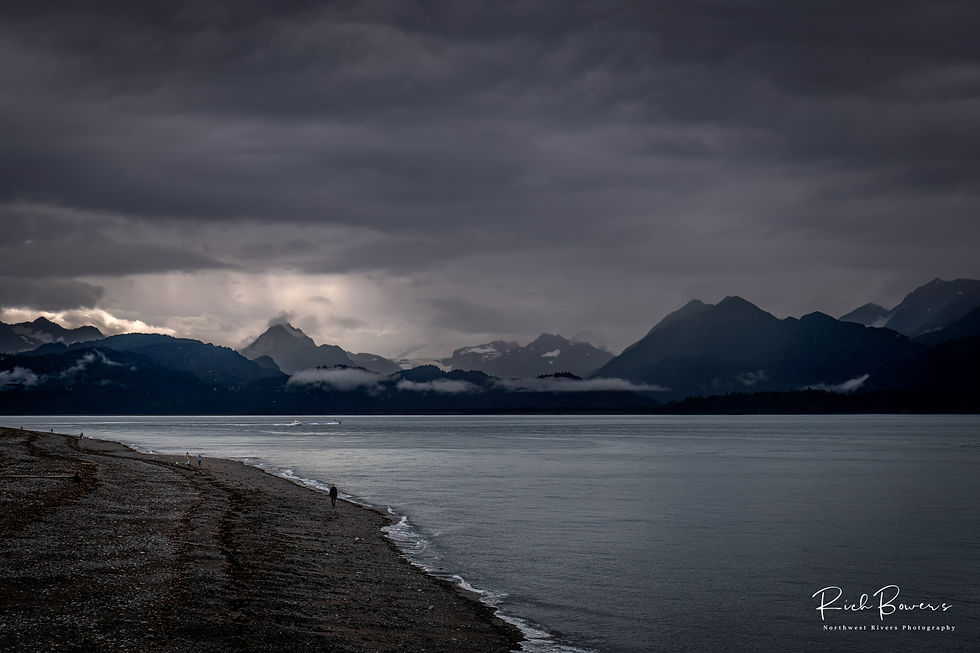
The drive to Homer is definitely another “end of road” trip, and one of my very favorite destinations. When we reached the “spit,” we found ourselves tired, out of pavement, and gazing westward across Kachemak Bay and Cook Inlet. It was hazy, and so we could not make out our destination (by boat) for the next day, Lake Clark National Park and Preserve, and we could barely make out the volcanoes across the bay in the Aleutian Range: Mount Redoubt, Iliamna, Augustine, Douglas, and Mount Spurr.
In addition to being attracted to end of road adventures, I also prefer the shoulder season. The end of seasons means less wildlife (including mosquitos), but that just means you need to look harder and do your homework, learn about the habits of moose, bear, and other critters so you know where to look.

This is trickier in Alaska, where Labor Day is the end of the tourist season and a hard close for most businesses. And “fall” in Alaska can last a short seven to fourteen days before the snow comes down from the peaks and winter arrives. Less tourists, less warm weather, and less open restaurants. Local slang refers to this as the “terminal dust” season for the very first dusting of snow in the mountains which signals the termination of summer and the tourist season. As one example, our planned flight down to Brooks Falls in Katmai National Park was cancelled because our guide decided to go moose hunting. Our replacement flight was cancelled due to high winds.

What do you do when you reach that proverbial end of the road? You have a few options, all of them good depending on your time, imagination, and resourcefulness.
You can, at some point, turn around (not really another option on a one-way road). That road back will be as spectacular as the road out, especially in Alaska. New views, new perspectives, and the opportunity to catch all that you missed the first time out. The end of that road is also its beginning!
On this trip, we were in no hurry to go back. We planned to push those end of road boundaries by plane and boat. While our plane flights in the Kenai never got off the ground, we had a fantastic day motoring over to Lake Clark National Park and Preserve. Rafts of sea otters, more than we had seen ever before, both tufted and horned puffins, kittiwakes, murres and murrelets, guillemots, and storm petrels. The bay was alive with birdlife and otters.

Lake Clark is huge! Over 4 million acres straddling the Chigmit Mountains and containing coast, lakes, rivers, wetlands, tundra, and boreal forests. As our boat came closer Lake Clark appeared grey in the rain, but we were still able to see Mount Redoubt and Mount Iliamna, both snow-clad volcanos rising over 10,000 feet and located in the park (Iliamna has fully ten glaciers radiating from its peak). The park bridges the Aleutian and Alaska Ranges, and the glacial rivers, peaks and spires are truly inspiring.

But all of that amazing mountainscape and magnificence was short lived as we approached the shore to find brown bears swimming, napping, and fishing along the sand. At one point, we counted fourteen bears asleep on the sand ( the bears nap in shallow water to cool off and protect them from mosquitoes). Ninety-five percent of brown bears in the United States live in Alaska, and Lake Clark Park staff has counted 219 brown bears within a 54 square mile area on the coast in recent years.
We spent our day off-shore and on land watching these bears as their lives played (or napped) out. An incredible opportunity to spend time with these animals, and to be allowed, if just for this one day, to appreciate the wonderfulness of nature in the wild!
It really was worth driving to the end of the road, and going beyond!
Endnotes:
· We had hoped to fly down to Brooks Falls in Katmai National Park, but high winds made flying dicey at best. The original plan was to arrive just in time for Fat Bear Week, but even the annual tournament was delayed. Not because of wind or rain, nor dwindling salmon, but because so many people voted this year that the park’s server crashed.
· In researching this year’s Fat Bear Week I ran across an article on salmon recipes titled “Eat Like a Fat Bear.” Enjoy!
· Fat Bear Week- and the winner is!



Comments